Ww2 Cromwell Tank - Tank, Cruiser, Mk VIII Cromwell (A27M), also known as the Cromwell, is a British tank of World War II.
The British Army in the 1930s believed in a division of labor between tank heavy infantry to gain breakthroughs and tank light cavalry to exploit those breakthroughs. The last category was the Cruiser Tank. Pre-war cruiser designs, such as the Crusader, were poorly armed and lightly armed. As early as November 1940, the War Office predicted the appearance of a column lagging behind German tanks. In January 1941 a heavy cruiser of 24 tonnes, 75 mm gun and 57 mm gun was specified. The first completed design to these specifications was the cruiser Mk VII Cavalier which went into production in 1942 without being fully developed.
Ww2 Cromwell Tank
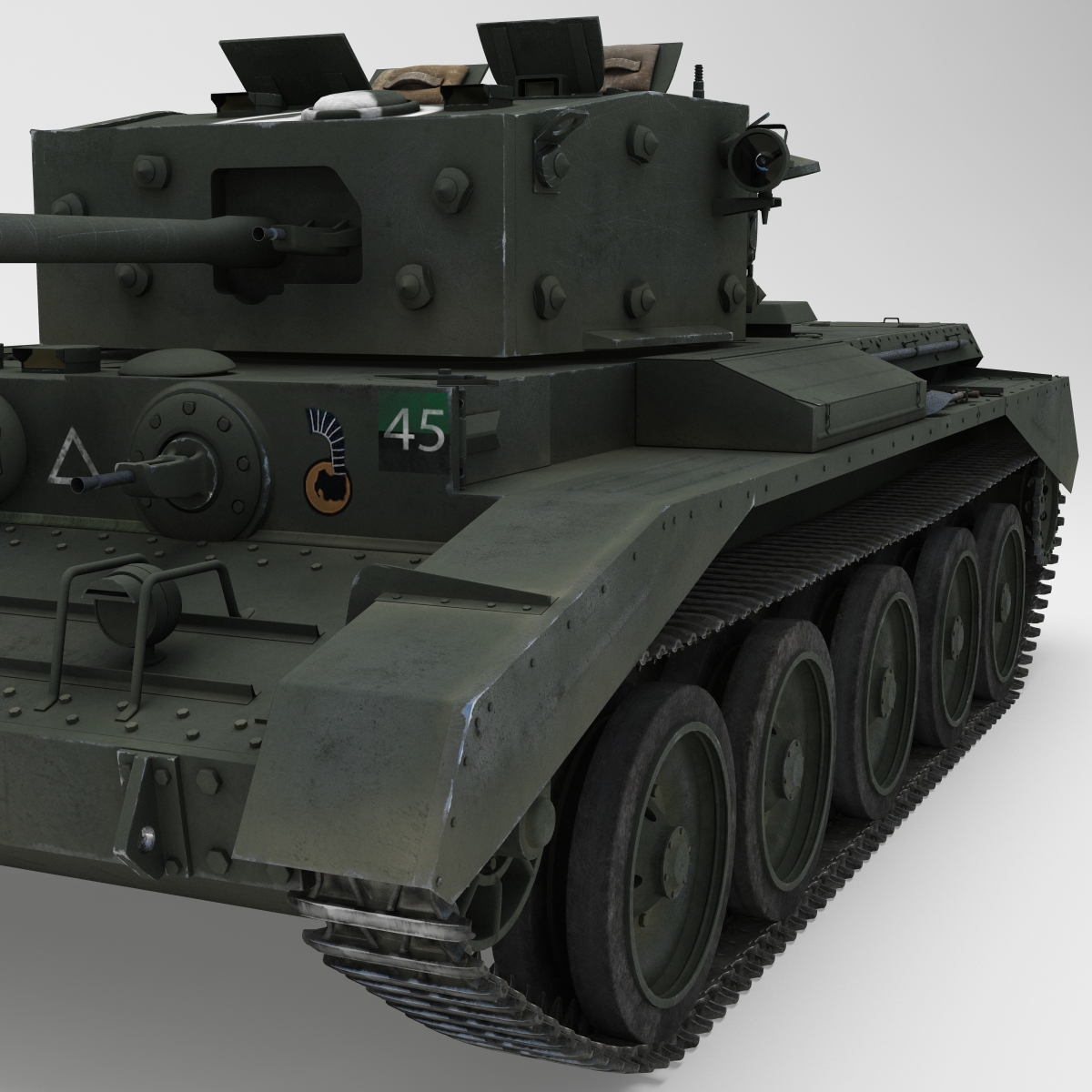
Better staged was another project, the A27 Cruiser Mark VII, from Leyland Motors. Due to lack of engines, there were two models: the A27(M) Cromwell with a 600hp Meteor aircraft engine and the A27(L) Centaur with a 395hp Nuffield Liberty engine. The Centaur was developed from November 1941, the prototype was ready in June 1942 and production started in Leyland towards the end of that year. The Centaur was somewhat like Cromwell's outwardly; when some Centauri received the Meteor engine in 1943, they were called Cruiser Mark VIII Cromwell Mark X.
A27m Cromwell Iv
Cromwell, named after Oliver Cromwell (originally the Cavalier was to be called Cromwell I and the Centaur the Cromwell II and this was to become Cromwell III; due to possible confusion with translation names, the separate names of the designates), was developed by the Birmingham Railway Carriage and Wagon Company from September 1941. This model was ready in January 1942; had a 57mm gun. This weapon had a high penetrating power and was therefore effective against tanks, but the high-explosive shell was too small to have much effect against simple targets such as infantry. So on 3 January 1943 it was decided to build a heavy 75mm gun from the Cromwell IV; some of Centaur's production power was used for this purpose. The gun was a six-pounder with a ported barrel.
In 1943 total production rose to 1854, of which 1261 Centaurs and 593 Cromwells. Of the Centaurs, 1037 were equipped with six-millimeter guns, 160 with 75mm howitzers and 64 with 95mm howitzers. 39 Cromwell Mark Xs were built, 334 Cromwells with six-pounders and 220 with 75mm gun.
In 1944 production increased slightly to 2080, including 145 Centaurs and 1935 Cromwells. Of the Centauri that year, 22 had a 6mm gun, 73 had a 75mm, and 50 had a 95mm howitzer. No more Cromwell Mark Xs were built, just 23 six-pounder Cromwells, 1604 with a 75mm gun and 308 with a 95mm howitzer.
In 1945 production ended: 79 Cromwells were under construction, 46 with a 75mm gun and 33 with a howitzer.
File:cromwell Latrun Memorial 1.jpg
Total A27 tank production was 4016 of which 1408 were Centauri and 2608 were Cromwells. Of these tanks, 1419 carried a six pounder gun, 2142 a 75mm gun and 455 a howitzer. In addition, Centaur hulls were designed for later use as anti-aircraft tanks. Of these, 375 were made, 352 in 1944 and 23 in 1945; moreover, only 95 vehicles actually have anti-aircraft guns. So the chassis number of the A27 was 4391.
Pre-war British tank designs were often sloppy: they could be seen as coming from a tradition still existing in the 19th century, whose modernity and performance had gone unnoticed. . When in 1940 it was suddenly predicted that British tank production would surpass that of Germany, this caused many problems because it was not possible to produce complex structures in large quantities at low cost. In response to this, attempts have been made to keep the new designs very simple, and the Cromwell is simple in its own right: she has a rectangular box for her hull and turret, although a hexagon, it approximates a square well. Since the frontal armor was immobile, the bouncing effect could not be used, and the shape of the armor is also not an effective way to cover the given volume. The fact that the weight is only 27 tons is due to the narrow back and weak armor. That narrow pocket could only hold a weak gun – in an inconspicuous flat turret – and the 75mm ammunition size was already very scarce before 1943 and was easily penetrated by many German tanks. Thus, the project has little defense and firepower; only its successor, the A34 Comet, would provide a satisfactory example of this. Cromwell's strength lies in his Meteor aero engine: so powerful, in fact, that the engine had to be lightened to 575 horsepower so as not to overload the machinery. The Cromwell also has Christie's suspension superior to its predecessor, with five-way wheels per side, each independently sprung from a large, nearly straight one integrated into the fuselage. The combination produced a tank that was both tactically and logistically more mobile than its German rivals, which the Cromwell could outrun at 42mph; the less efficient engine allows a maximum speed of 53 km/h.
The Cromwell's importance was greatly reduced as many British Army units were equipped with the American M4 Sherman. Many of the vehicles remained in England for training or were converted into support vehicles. A variant of the Cromwell with a 75 mm gun was used with the 11th Armored Division and the Normandy Landing Guards with special artillery reconnaissance units as a supplement to the Sherman, in the old cavalry duty: strategic reconnaissance. Its high speed made it suitable for this project. The 7th Armored Division was heavily equipped with Cromwells. The Polish 1st Armored Division also had such an army, and the Czech armored brigade was also equipped with Cromwells. He later replaced the Tetrarch in the 6th Airborne Reconnaissance Regiment.
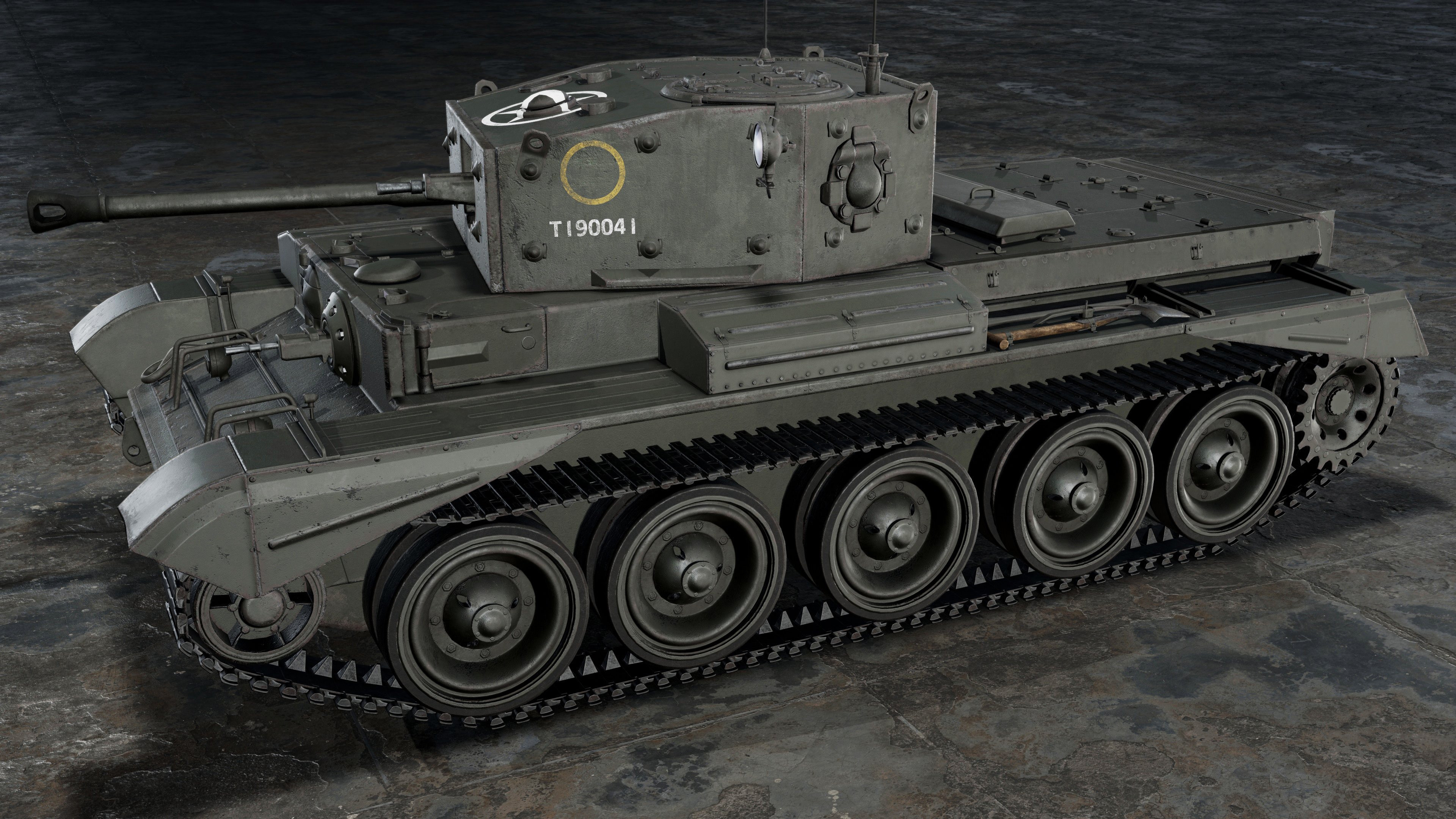
To compensate for the lack of anti-tank firepower, each squad was issued a Sherman Firefly with a 17-pounder gun. While the Cromwell was no match for its German rivals, it was still a significant improvement over earlier British tanks and was effective in combat, largely because the rate of fire of light shells was too high.
British Tank Cruiser Mk.iv Cromwell A27m In The Museum Of Military Equipment Editorial Image
After the war, four more that were not seen were used by Israel from 1948 to 1952. Many were also employed by Fiand.
The Centaur is armed with a 75mm ROQF Mk V cannon. In 1943 most of the Centaur I was upgraded to this standard.
Centaur armed with a 95 mm howitzer (51 rounds). This is the only Centaur type that has actually seen combat, with the Royal Marines' Armored Support Group. Cars were designed to be waterproof.
The current Centaur I updated with the Meteor V12 engine was designated Cromwell X; 39s were relaunched under this name and designated the Cromwell III.
Cromwell British Tank Mk Viii,(a27m) Ww2
The existing Cromwell IVs and Vs were upgraded with 101mm thicker armour, wider tracks and a reinforced gearbox.
Parts of the Cromwell were to be used in the A 30 Challenger (essentially a tall turret Cromwell) and the Avenger and the experimental A33 Assault Tank.
Anti-aircraft tank with Crusader III, AA Mk II turret armed with twin 20 mm Polsten cannon. This type was used in Normandy.

Improved anti-aircraft tank with Crusader III, AA Mk III turret. A total of 95 cars of both models were built.
Tamiya 300035221 300035221 1:35 Wwii Britse Tank Cromwell Mk.iv Cruiser (1), Getrouwe Replica, Plastic Bouwpakket, Knutselen, Modelbouwpakket, Montage, Ongelakt
This was a centaur converted to a bulldozer with the tower removed and a winch installed. This car was one of Hobart's Funnies. A total of 250 were made in 1945.
The Centaur has been converted into an artillery observation vehicle with long-range radio equipment. A dummy external cannon replaced the real one in order to have more space available in the tower.
In the 1950s, the British Army found that the maneuverability of their medium weight Centurion was sorely lacking. It was decided to convert the existing Cromwells, which were completely obsolete, into a fast tank destroyer. The fact that the turret circle was really too small for a modern powerful gun was overcome by installing a high tower. From 1954 onwards, 200 vehicles were fitted by Robinson and Kershaw Ltd with the 83.4mm 20 pounder gun, similar to the Centurion of the time. The vehicle was called FV 4101 Charioteer Tank Destroyer.
Once the vehicles were ready, the Army decided that the 83.4mm gun was too weak against the Soviet T-54. The Motorists were then turned over to the Home Army and soon sold to Austria (80) and Fiand, who would use the 38 vehicles until 1979. Jordan had already received the Motorists 24 in 1954; then he allegedly sold them to Lebanon, where they fell into the hands of various groups of soldiers.
Cromwell Tank Ww2
Sherman Firefly Vickers Tetrarch light tank Crusader Cromwell Matilda I Matilda II
Making poll, poll page, civiqs, employee poll, poll biden, swiming poll, brass poll, poll decks, newsmax poll, poll apps, camera poll, bias

0 Comments