Bayonets Military - This article contains a list of general references, but lacks sufficient corresponding online citations. Please help improve this article by introducing more accurate citations. (July 2015) (Learn how and how to delete this template message)
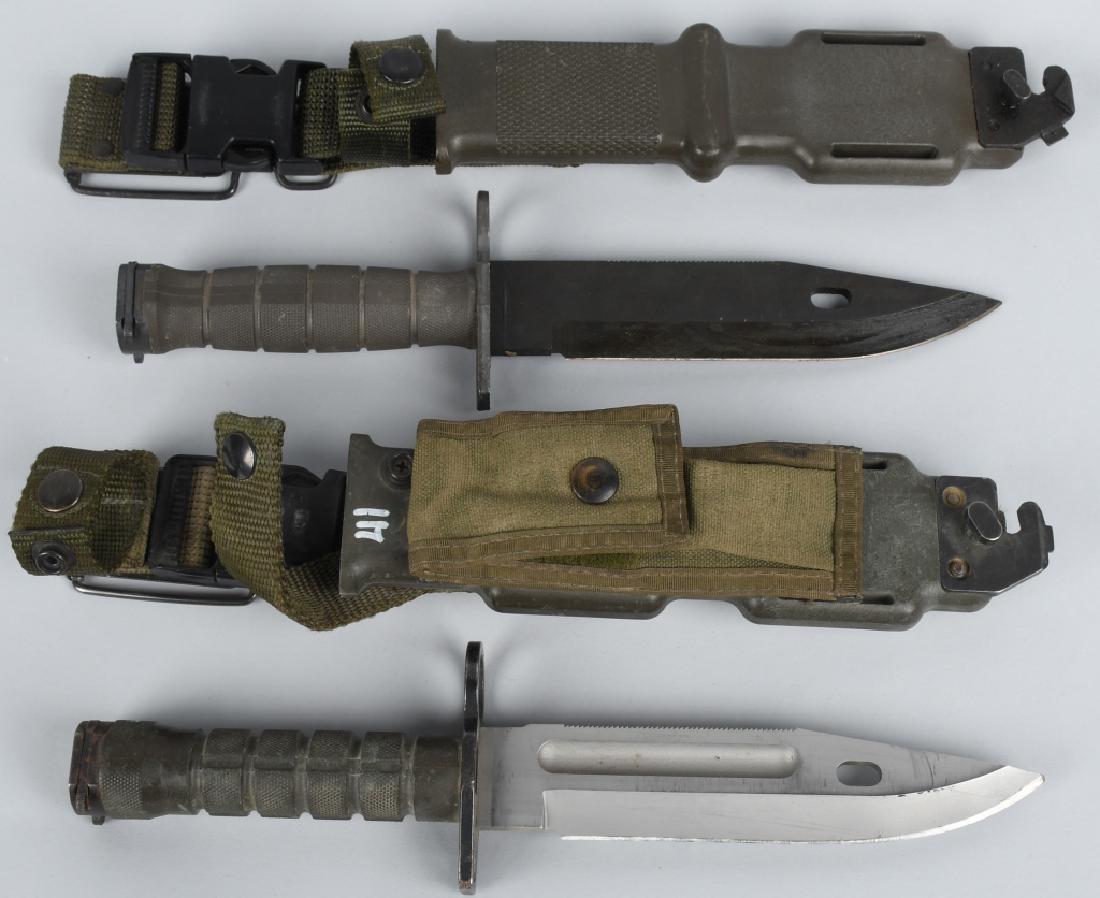
The M9 Bayonet, formally known as the M9 Flobis III, is a multipurpose knife and bayonet officially adopted by the United States in 1986. It has a 7 inch (18 cm) blade and comes with a sheath designed to double as and a wire cutter.
Bayonets Military
He then built it under the name Flobis III and fulfilled a military contract for 325,000 units. Buck Knives signed a contract to manufacture 300,000 units and sell a commercial version under its own name. The fin design was so popular that it was widely counterfeited and sold illegally by other manufacturers.
Military Surplus Swiss Sig 57 Bayonet With Scabbard
In 1989, Finn received US patent No. 4,821,356, but unauthorized copies from Asia and Mexico continued to flow into the United States, preventing legitimate sales.
After the contract for the Flovis III bayonet was completed, the rights to the M9 were returned to the US Army, and several other versions were issued later. It is issued by the armed forces of the United States and other countries and sold commercially in various versions.
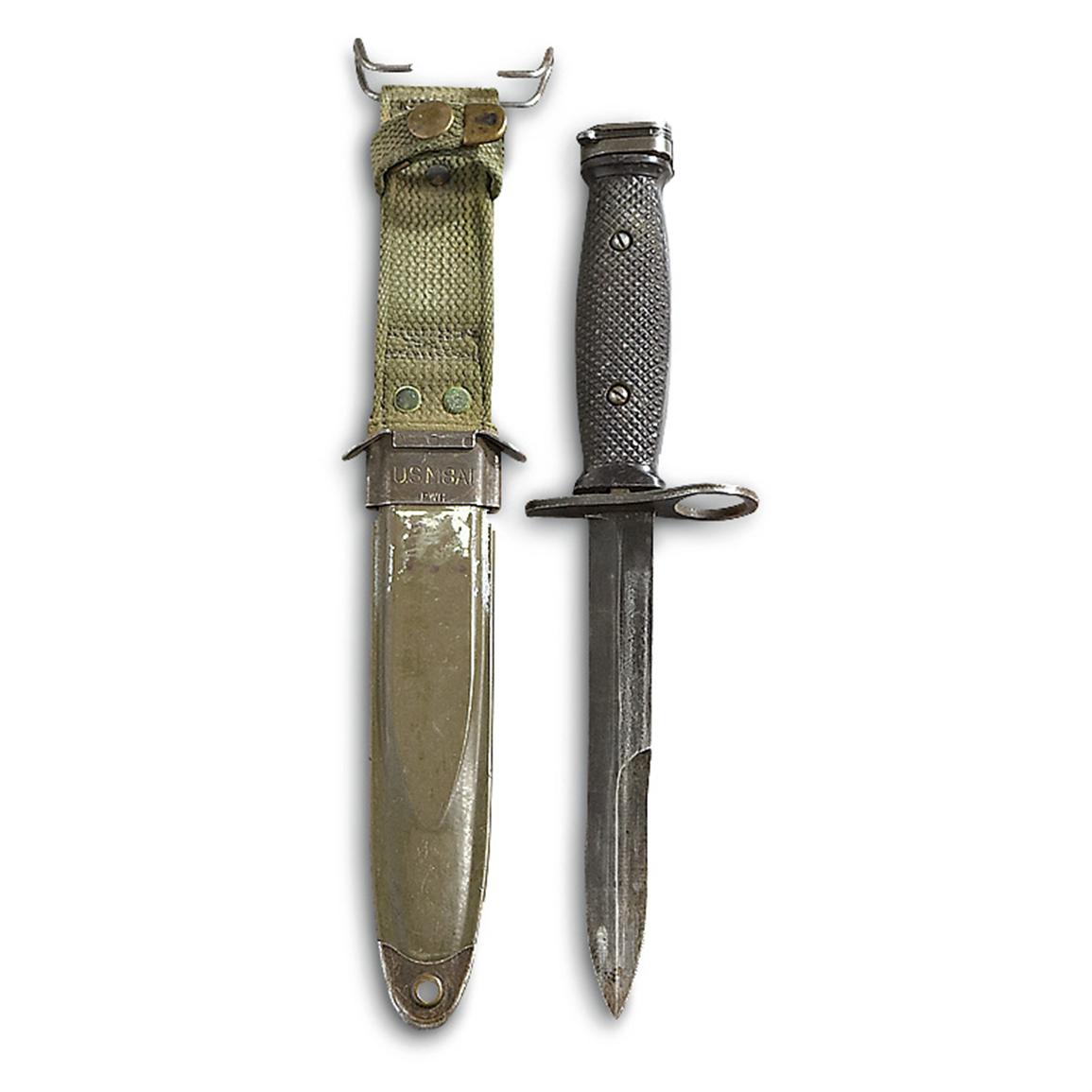
Some of the productions of the M9 are more or less perfect, depending on the contractor who produced the batch and the military specifications of the time. The M9 bayonet partially replaced the older M7 bayonet introduced in 1964. The M9 is said to be more prone to breakage than the older M7, but the M9 bayonet has a 20% thicker blade and tang (0.235" vs. 0.195"). ") and the cross-section of the steel blade is 75% larger than M7.
M11 Knife (Not strictly a bayonet, as it lacks a mounted catch or muzzle ring. An improved version of the Buckmaster 184/188 knife on which the Phrobis XM-9 bayonet prototype was based.
Australian Military Rifles And Bayonets By I Skennerton
), or M11 EOD, is a version of the M9 specialized for explosive ordnance disposal (EOD). It uses the same blade and sheath as the M9, although it has some additional features, such as a hammer pommel.
There are five main manufacturers of the M9: Phrobis, Buck (a subcontractor of Phrobis III during its first Army contract), LanCay, Ontario, and Tri-Technologies. From 1987, Flobis began to subcontract Buck, which ended in 1989. It was during this time that Buck also launched the commercial M9, which remained on sale until 1997.
LanCay (taking over production from Buck) signed its first contract for 30 (later 50) thousand knives (with General Cutlery as a subcontractor) in March 1992. In 1994 there was another contract issued for about 100,000 improved M9 models. In 1999, a contract for 25,000 knives was split between LanCay and Ontario (12,500 each).
The Ontario Knife Company also participated in subsequent agreements and is currently (since 2005) one of the manufacturing contractors. These can be identified by blades marked "M-9/ONTARIO/KNIFE CO/USA".
Military Knives, Bayonets, Swords, Etc.
Introduced in 1964, the M7 bayonet was used as a bayonet for the M16 rifle and as a combat knife. The M9 Multipurpose Bayonet System is used as the bayonet for M16 series rifles, as the bayonet for M4 series carbines, as combat knives, as general field knives and utilities, such as wire cutters used in sheathing, and as saws. The M9 also fits the Mossberg 590 Special Purpose Shotgun.
An overview of the M9 type from Buck Knives, one of the makers of the M9 bayonet. 5,000 US Marines are included in the US Army numbers in this list.
This section does not cite sources. Help us improve this section by adding citations to reliable sources. Unsourced material may be challenged and removed. (October 2017) (Learn how and how to delete this template message) U. WWII military bayonet. Shown are the M1905 bayonet (blue version), the M1 bayonet, the M1905E1 wedge-point bayonet (the cut-down version of the M1905) and the M4 leather-handled bayonet for the M1 carbine (below).
The M4 Bayonet, like the M3 Fighting Knife before it, was designed for rapid production using a minimal number of strategic metal and mechanical processes, with a relatively narrow 6.75-inch bayonet-style blade. He used a spear point blade and a sharp 3.5. secondary blade inch. board
Akm Bayonet With Saw And Sheath
The blades were made of carbon steel and were either blued or parkalized. The manufacture of the grooved wooden handle was later simplified by forming the handle of stacked leather lavands formed by the rotation of a lathe, then sandblasted and lacquered, it has a bayonet muzzle ring, and a faster bayonet is on the pommel. Later models used black molded plastic handles. The basic design is used for the later M5, M6 and M7 bayonet.
There are two variants of this liner, both with an olive drab fiberglass body with a steel throat. Early versions of the M8 scabbard had only straps, and earlier bayonet scabbards lacked double hooks for attachment to load-carrying equipment such as the M1910 Haversack. A modified M8A1 scabbard manufactured in late WWII has a M1910 bt wire hook. The sheath throat flange is stamped "US M8" or "US M8A1" on the flat bar with the maker's initials. Some M8 helmets were later modified with the addition of M1910 hooks. Later M8A1 bayonets were manufactured with modified extension tabs on the hanger web to provide more clearance for the M5 bayonet to rub against the wider bayonet handle. It was also used on the M3 Fighting Knife.
Ww2 bayonets, military bayonets identification, antique bayonets, bayonets, us military bayonets, military surplus bayonets, military bayonets for sale craigslist, antique military bayonets, military bayonets, military bayonets sale, old military bayonets, military bayonets ebay

0 Comments